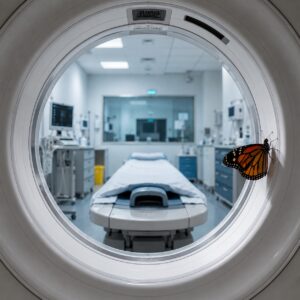
 Most people undergoing a CT scan give little thought to the contrast dye that may be used during the procedure.
In many cases there is no reason to. Iodinated contrast media helps improve image quality, provides valuable diagnostic information and is used safely every day in hospitals and radiology clinics around the world.
What many people do not realise, however, is that these contrast agents contain very large amounts of iodine.
For most individuals this is unlikely to cause a meaningful problem. For some people with underlying thyroid disease, particularly autoimmune thyroiditis such as Hashimoto’s disease, the situation may be more complicated.
Why iodine matters
The thyroid gland requires iodine to manufacture thyroid hormones. Without sufficient iodine, thyroid hormone production falls, which is why iodine deficiency remains an important cause of thyroid dysfunction in some parts of the world.
Iodine deficiency is widely recognised as a cause of thyroid dysfunction. Less attention is given to the fact that sudden iodine excess may also affect thyroid function in susceptible individuals.
The thyroid possesses sophisticated regulatory mechanisms that normally protect it from sudden increases in iodine intake. One of these is known as the Wolff-Chaikoff effect. In simple terms, when the thyroid is suddenly exposed to a very large iodine load, it temporarily reduces thyroid hormone production. In healthy individuals, the gland usually adapts and normal thyroid function resumes.
In some people, however, this adaptation may not occur as effectively.
Where Hashimoto’s changes the conversation
Hashimoto’s disease is an autoimmune condition in which the immune system targets thyroid tissue. Many people have elevated thyroid peroxidase (TPO) antibodies for years before thyroid hormone levels become abnormal, while others already have established hypothyroidism requiring treatment.
Research over recent years has identified autoimmune thyroiditis as a recognised risk factor for thyroid dysfunction following exposure to iodinated contrast media.
The concern is not that every person with Hashimoto’s disease will experience a problem. Rather, it appears that individuals with autoimmune thyroid disease may be less able to adapt to a sudden and substantial iodine load than those with completely healthy thyroid tissue.
The 2021 European Thyroid Association Guidelines specifically identify autoimmune thyroiditis as a recognised risk factor for developing hypothyroidism following exposure to iodinated contrast media.
It is also worth noting that patients already receiving stable thyroid hormone replacement therapy are generally not considered at increased risk in the same way as those with untreated or evolving autoimmune thyroid disease.
How much iodine are we talking about?
The recommended daily intake of iodine for Australian adults is approximately 150 micrograms per day. A contrast-enhanced CT scan typically delivers between 15 and 37 grams of total iodine, with some procedures using even larger amounts.
At first glance, this sounds alarming, but there is an important distinction to understand.
Most of the iodine contained within contrast media is chemically bound to the contrast molecule and is not immediately available for uptake by the thyroid. However, a typical CT scan still exposes the body to approximately 2,500 to 5,000 micrograms of bioavailable free iodine.
That means the amount of free iodine alone may be equivalent to roughly 17 to 33 times the recommended daily intake.
Studies have shown that iodine stores can remain elevated for weeks following a single contrast-enhanced CT scan. In healthy adults, urinary iodine levels may not return to baseline for more than six weeks after exposure. This prolonged elevation in iodine exposure may help explain why thyroid dysfunction sometimes develops weeks after the scan rather than immediately.
For most people this does not result in clinically significant thyroid dysfunction. The thyroid’s normal protective mechanisms are usually capable of adapting to the sudden iodine load.
The risk becomes more relevant in individuals with pre-existing thyroid disease, where the ability to adapt to sudden iodine excess may be less reliable.
What can happen?
In people with Hashimoto’s disease, the primary concern is the development or worsening of hypothyroidism.
Some individuals experience a temporary change in thyroid function that resolves spontaneously. Others may develop more persistent abnormalities requiring monitoring or treatment.
While hypothyroidism is the principal concern in autoimmune thyroiditis, excessive iodine exposure can also occasionally trigger hyperthyroidism in susceptible individuals with other underlying thyroid conditions, such as nodular thyroid disease or latent Graves’ disease.
Importantly, thyroid dysfunction may not become apparent immediately. Changes can emerge some time after contrast exposure, making the association easy to miss unless thyroid function is being monitored.
Does this mean contrast should be avoided?
Not necessarily.
Contrast-enhanced CT scans provide valuable information and, in many situations, the benefits clearly outweigh the risks.
The goal is not to create unnecessary concern about medical imaging. Rather, it is to ensure that recognised risk factors are considered when decisions are being made.
If a scan can provide the necessary information without contrast, that may be worth discussing. If MRI is a clinically appropriate alternative, that may also be considered in some situations. If iodinated contrast is required, monitoring thyroid function before and after the scan may be appropriate for higher-risk individuals.
The bottom line
Iodinated contrast media is an important diagnostic tool and should not be viewed as inherently dangerous.
However, patients with autoimmune thyroid disease represent a recognised higher-risk group for iodine-induced thyroid dysfunction.
One of the more interesting aspects of thyroid physiology is that both too little iodine and too much iodine can create problems. Most discussions focus on deficiency. Far fewer focus on the effects of sudden iodine excess in individuals whose thyroid function may already be vulnerable.
For people with Hashimoto’s disease, positive TPO antibodies or existing thyroid dysfunction, it may be worthwhile discussing imaging options and thyroid monitoring with your healthcare practitioner before undergoing a contrast-enhanced CT scan.
Awareness does not mean avoiding necessary medical care. It means making informed decisions based on a clearer understanding of both benefits and risks.
Article written by
Peter Christinson
Certified Practicing Nutritionist
Vive Health – Retail and Clinic Manager